Thursday, 3 March 2016

Game 38 : Eylau 1807

This game was fought in December, oops for the delay in posting. Eylau is the famous battle where snow played havoc with visibility and sense of direction and resulted in the Corps of Augerau being effectively wrecked.
This game would see similar results, but the impact was disastrous for the Russians. Eylau is a well known battle so I will leave readers to refresh themselves as to the layout of the battlefield and the opposing forces. The deployment of both sides, as it happened, largely mirrored historic deployment and so without further delay!
 
 
This is the Russian right flank. Eylau is in the upper middle right of the picture


This is a head on view of Eylau viewed from the Russian lines


The Russians started an attack from the right flank. Part of the reasoning, not unreasonably, was to get to grips with the weak French left and hopefully draw reserves I this direction. L'Estoq and Ney were being played historically, both would arrive at some point.


The French plan was similar. Drive forwards on the Russian right, engage until is was unsafe due to numbers and the retire to the original starting positions. The result of this was Soult's smallest Division attacking twice its numbers. But the tactic would pay dividends. The entire Russian wing would end up getting embroiled in this fight.


Augereau advance against the Russian left, predicting the arrival of Davout. The idea is to fix the Russians and then destroy them piece meal. However, the Russians have no intention of just sitting there. They attempt to retire to forma new line, expecting an attack on an exposed flank.
 

The Russians start to redeploy as Davout has started to arrive to their rear. Their timing was quite good and the chase was on to trap these Russians.

 
Davout's flank attack has carried the flank, but unfortunately it has attracted the attention of all the Russian reserves. Davout begins to redeploy to face this onslaught! But help  was at hand.

 
 More Russian reserves preparing to attack Davout.
 

On the Russian right, the fight for the village reaches a pivotal point. The entire French Division is committed against their larger sized counterpart. The end result would be a victory for the French and the capture of the village. It would be short lived as the Russians quickly rally and prepare to retake the village. The French would not trust their luck a second time and so retire.
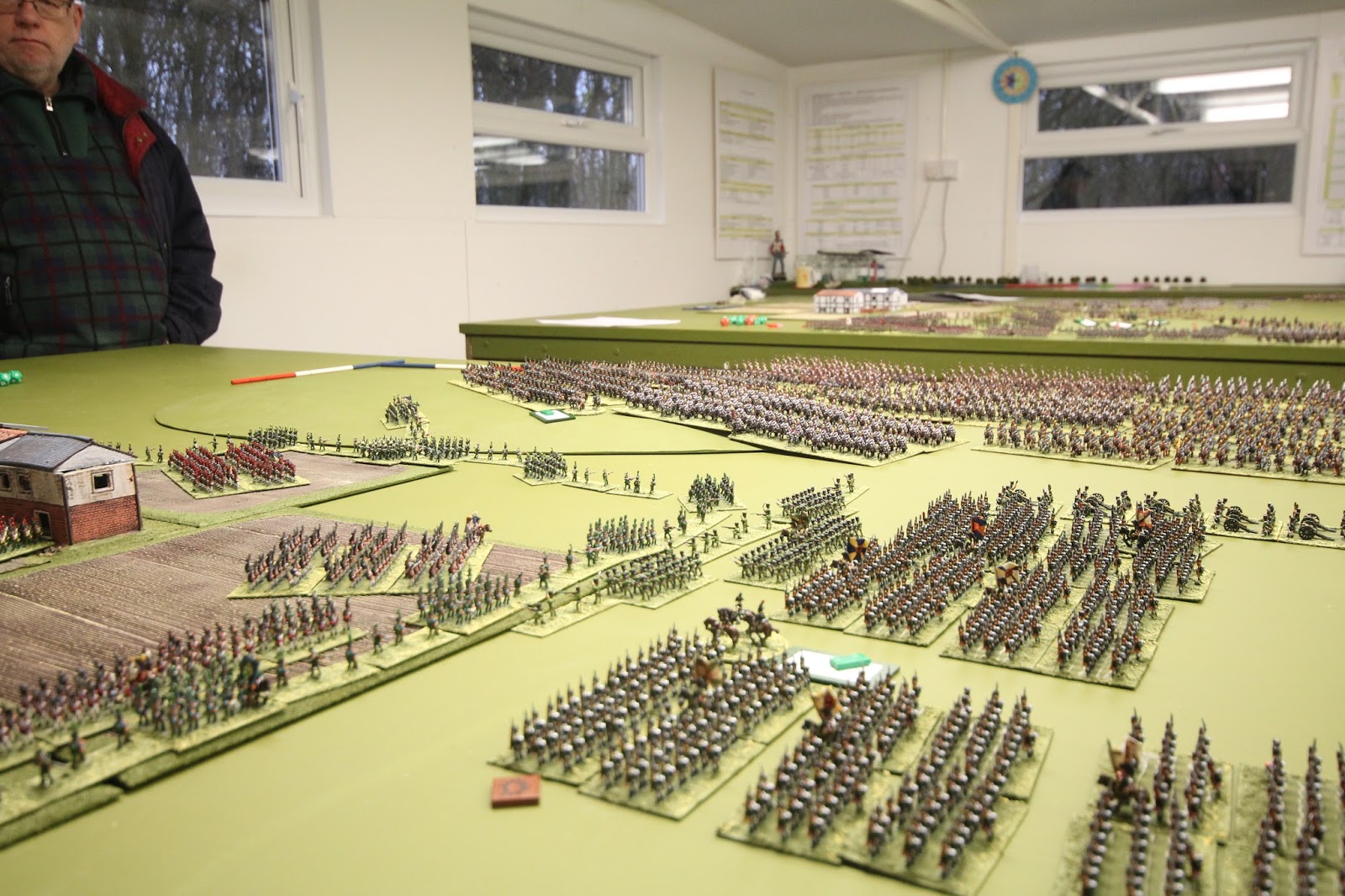


The French have cleared the first village on the Russian left flank and are now moving to rescue the flank attack itself at the second village. Just behind, you can see the French Reserve cavalry being launched at the Russian left centre where a hinge is being formed as the French force back the left flank.

 
This shows the cavalry manoeuvre from the Russian centre.  
 

The French centre continues with its attack. In the bottom right of the pic, you can see Russian cavalry that initially tried to halt this attack and then found themselves out of position and not being able to use their numbers. They are trying to quickly extricate themselves and redeploy. Not too easy in snow!


The Russian cavalry, along with the Russian reserve, now add their weight against Davout. 


A French man with a smirk as Soult disengages his Division from the village fighting on the left and takes up new positions to face of L'Estoq, who is expected at anytime.


French cavalry begin to swarm through a gap at the Russian hinge. This attack would be the critical part of the battle.


Soult relaunches his attacks on the left flank with his remaining two Divisions. L'Estoq has also arrived. The Russians and Prussians also attack.


The French left repulses L'Estoq's cavalry, just!!

 
Soult's troops advancing with their own cavalry support from massed Light cavalry Regiments.
 
 
And a last[pic just to show the free for all that sometimes occurs. Troops everywhere going in all directions! Great!!
 
 
Well, four of us are having a good time, not sure about the guy in the front!?!?! He's lucky, just retired. Younger than me! Shouldn't be allowed!
The next game will be a short report from a "bout of madness" that has already taken part. A very large WWII game on 600 square feet of table in a hotel with 20 players. I know I am mad, but this just confirms it!!

Sunday, 13 December 2015

Book Notice

Hi Guys,
The first Companion book on the 1809 Danube campaign is available from Caliver. It has maps, OBs and discusses some specific aspects of the rules. Full of actual pics from the actual battles. I hope some of you enjoy it.
Cheers
Ged

Monday, 23 November 2015

Game 37 : La Rothiere 1814

This game is from the 1814 stable and was the first major engagement. It was precipitated by Napoleon deciding to engage a larger allied army and giving it a bloody nose before withdrawing from the field.
This time I've added a map as I intend just talking about the pics. The French lines are from La Rothiere, then east and west in the villages and the lines of communication are to the north. The Allies are deployed in front of the French army.
This turned out to be action all the way and the most dramatic of the medium sized battles fought so far and great fun. I'll leave people to look up the OBs themselves but the French are outnumbered. So they attacked!!

This is looking from Dienville to La Rothiere. Apart from the villages, the terrain is very open.


The French Young Guard, deployed on the right flank, launch themselves against the Allied left flank. This caught the Allies unaware and formations out of position and would hinder the Allies all battle.


Looking from Dienville towards La Rothiere is the Reserve cavalry, primarily Dragoons. These brave men would execute countless charges to keep the Allies fixed in position to allow the right flank attack to gather momentum.


This is the Allied left that faced the French Young Guard attack. The light cavalry would get hemmed in and by the time they extricated themselves the French Young Guard would fall on the infantry supporting them.


Further along the Allied line towards La Rothiere. The French Cavalry Reserve would have to fend off these Divisions for the whole battle. It would be plain sailing for the French.


This is from behind the Allied left. The French cavalry can be seen are trying to keep a distance from a concentration of Allied guns. These guns would ultimately cause heavy losses as the French cavalry would launch many charges.


The Allied centre with La Rothiere just in view. This column is going to attempt to outflank La Rothiere to the left. The Allied cavalry to the top left would protect the flank of this advance.


At the same time, Allied columns were advancing to the right of La Rothiere. A pincer movement was being executed with a screening in the centre of the village.


Towards the Allied right flank, the French in the background are waiting to launch their own attack. The French are waiting to draw the Allies into committing themselves against La Gibrie. The Allies would not play ball forced the French to attack.


The French use the cover of La Gibrie to prepare their own attack. The flank support, yet to be seen, would be the Guard Cavalry which was deployed between La Gibrie and La Rothiere.


The French left flank to the right of La Gibrie. A powerful Allied battery would have to be engaged and silenced to allow this attack to work.


This is the Allied right flank redeploying to face the attack from the French left. The powerful gun line is being constructed. The Allies were weak in cavalry in this sector, a lone regiment can be seen behind the gun line to the left of the pic.


Viewed from the French line just left of La Rothiere, the Allied central attack against La Rothiere is sent in, in force. The French position was well covered and although the fight would last some time, the defenders would hold the day. The church, a significant defensive position, would repulse all assaults that numbered double digits.


The French garrison deployed and prepared to defend against the assault of La Rothiere.


Meanwhile, on the French right flank, the Young Guard are advancing and sweeping all before them. To aid this, the French Reserve cavalry has launched several cavalry charges against Allied guns lines and cavalry supports so that they cannot react to this French movement.


The French cavalry reserve is committed en masse. The Dragoons are off table and now the lights are having to face Allied cavalry that outnumber them significantly. French horse artillery prepares to deploy to aid the cavalry.


The rallied Dragoons now advance after the Allied cavalry were repulsed. All three regiments of this Division would assault the Russian gun line. Losses would be horrible!!


Calmness is restored in La Rothiere as the Austrian assaults are eventually driven back. The Allied would not get a toe hold in the village.


The Allied right wing advance to face the French attack from the left. It would halt when the French Guard cavalry advanced. The extreme right of the line would then come under intense pressure from French infantry.


French infantry executing the left flank assault against the Allied right flank. Russian guns would wreak havoc for a while and the succumb to gradual losses and French charges.


The Allies are trying to organise another assault to the right side of La Rothiere. The central repulsed column can be seen as it reorganises itself.


Here you can see the French left flank assault, above the stick, descend upon the Allied right flank.


The final assault against La Rothiere. The Austrians would give one final attempt, but the French would not yield an inch. The outcome of the battle was decided on the flanks.


The Allied left flank is now crumbling in a piecemeal fashion. Formations are trying to withdraw to escape the French Young Guard "grinding machine" as it inexorably continues to roll up the Allied line. Russian infantry fight bravely but suffer enormous casualties in trying to halt their retreat. 


The French Dragoons execute a last charge against a Russian square on the Allied hinge of their right. I can't remember what happened, but I'll have to make something up for the book!!


The French at La Rothiere have gone over on to the offensive and finally drive the last Austrian assault away from the village. The fight in the centre is over.


The French Young Guard, their victory complete, now drive on the Allied centre, the whole Allied right now withdrawing. The battle has come to a close.


Rogues gallery, all regulars now. It was a great game with lots of surprises and a lot of intense fighting. It also again demonstrated how command & control affects these games when gamers cannot automatically do what they want to do. Frustrating but more realistic!

The next game will be a biggy, Eylau. New snow rules to try out!

And finally, the first "Companion" book to the rules is at the publisher Caliver ready to print. It covers the 1809 Danube campaign and also discusses some rule aspects of "In the Grandest Manner".
Enjoy!

Wednesday, 21 October 2015

Game 36 : Saalfeld 1806

This is the smallest Napoleonic battle played so far. Two of us played this twice over the weekend. The game is set as prelude to Jena Auerstadt. It effectively pitches the advanced troops of both armies as they contest the strategic position and occurred outside the town of Saalfeld, a key communication town that sits on the Saal river.
The armies are roughly a division per side with an attached cavalry brigade. The French have what turned out to be a big advantage in that two Corps commanders were present in addition to a very capable divisional commander. The enhance command and control ability would be important.


We still used the whole table so space was not an issue, manoeuvring was not a problem either. This is looking from the south and Saalfeld is top right at the north of the battlefield. The game had three strategic objectives. They were the road network the exited Saalfeld to the north over the Saal river, the road to the south which is to the right of the above pic on the other table and the road to the west which is difficult to see but is positioned to the left of the village in the distance on the left table.


This shows the same area but from the southern road. Saalfeld is at the top of the pic. The French would arrive via two roads and cross country. The roads were to the east of the southern board edge and the road east of Saalfeld. A third force arrived cross country between these roads.
The Prussians and Saxons arrived via the road to the west and their arrival was generally more speedy than the French. Its a bit of a lottery as to who gets to hold the centre ground. Its down to tactics and bravado!!


This shows Saalfeld where the Saal river is off table to the north and the road leading east where the largest French infantry formation arrives.


This is a few turns into the game. This shows the central village which has been occupied by a small French light infantry brigade of 2 btns. Beyond this is the main Prusso-Saxon force and to the right of that is the largest French infantry brigade with the only foot battery on the French side. I said it was a smallish battle!


This is taken from Saalfeld looking south and east. The whole French force, bar a single cavalry brigade, which is in the right distance, off table, of this pic can be seen arrayed between Saalfeld and the central village. The French plan is to screen Saalfeld, advance the centre and secure the villages and turn the Prusso-Saxon flank by defeating the enemy cavalry, thus making the allied position untenable.
The Prusso-Saxon plan was to secure Saalfeld with the Saxons, hold the central position, drive away the French cavalry with their own and then to contest the centre villages.


This was the clash of the cavalry. Saalfeld is top right. It was here that the French had an advantage. The enemy cavalry was slightly better combat wise and had numbers, but the French had these extra commanders that would allow the brigade commander to personally lead his cavalry into combat. For the Prusso-Saxons to adopt the same strategy would be quite a risk and a disaster for the army if a general were to become a casualty. The French fought with their general, the allies did not. However, the hoped for French victory did not materialise. The cavalry fought to a stand off and the allies actually inflicted more losses. The cavalry would then effectively have little say on the outcome of the battle with regards to actual combat but their manoeuvring and potential threat could never be ignored.


Another pic showing the cavalry clash. A total of 5 regiments with the numbers favouring the allies, all the cavalry on the battlefield.


The cavalry clash is in the background and the Prussians in this pic are retiring to the line of the village and Saalfeld so as not to be outflanked if they lose the cavalry combat.


The French light infantry brigade in the centre has exited the village in the centre and is now advancing with the remainder of the French infantry in the background. The allies have yielded this lead village in the centre and are now redeploying to defend the centre village further west. Saalfeld itself is still securely in Saxon hands.
 
 
A pic from Saalfeld showing the French advance in the centre
 

The French cavalry is now trying to cut off the road to the west and also support the advance in the centre. The allied cavalry has also deployed to the west of the village to attempt to disrupt this plan and protect their own infantry in the centre. The French have managed to concentrate the majority of their infantry against the centre and the final attack is about to begin.


There are too many French for the allies to successfully hold as the Saxons are still bottled up in Saalfeld and screened by fewer French. The result is that this key sector cannot be held and the French assault is successful. The allies decide to withdraw whilst they still have access to the road to the west.

The commanders. The game ended in a French victory, influenced by the superior command and control. We turned the game around, and got exactly the same result!!
Next game is back to 1814 and is La Rothiere. Until then........